Myrtle Tree Ministry Strategies
Myrtle Tree Ministry Strategies
Self-Awareness in Service of the Call
THE ENNEAGRAM
What is the Enneagram?
The Enneagram describes nine patterns in how people think, feel, and act, and the motivations underneath them. For leaders, it puts words to how you handle pressure, conflict, and the people you serve with. We use it for self-awareness, never as theology or a box to put anyone in.
WHY INTEGRATIVE ENNEAGRAM (iEQ9)
Beyond the number.
Knowing your type helps only when the type is truly yours. Most quizzes measure behavior, but the Enneagram is about motivation, the why underneath, which is much harder to measure. Landing on the wrong type is easy.
Integrative Enneagram takes a more thorough approach, built around the iEQ9: an in-depth online assessment the publisher calls the most accurate and comprehensive in the world.
Built for accuracy:
- Questions adapt as you answer.
- Types that are easy to confuse get cross-checked.
- The publisher reports validation with nearly 64,000 people across five languages.
WAYS TO BEGIN
Choose the path that fits.
Member pricing and group packages are available for churches, associations, conventions, and ministry networks.
QUESTIONS
Fair questions, plain answers.
Is the Enneagram in the Bible?
The Enneagram does not appear in Scripture, and we never present the tool as scriptural or as equal to Scripture. The Enneagram describes the motivations behind how each of us thinks, feels, and acts. Christians have long held that knowing ourselves and knowing God belong together, and that honest self-knowledge can lead a person toward God. The Enneagram can help put words to patterns that are hard to see on your own, but naming a pattern does not change a heart. Lasting change is the work of the Holy Spirit, and Scripture remains the measure for everything the Enneagram brings to the surface.
Do Christians use the Enneagram?
Yes. Seminaries and churches across traditions, including Baptist, Presbyterian, United Methodist, and evangelical, have offered Enneagram courses and workshops, chaplains have used it in their training and care, and Christian publishers have released books on using it in spiritual formation and church leadership.
Christians who use the Enneagram treat the tool like counseling or a leadership assessment, as an aid to the honest self-examination Scripture calls for (Psalm 139:23-24; 2 Corinthians 13:5). Several Christian authors also argue that spiritual growth is not one-size-fits-all, because people are wired differently.
What is the history of the Enneagram?
The Enneagram of personality types was developed in the 1960s and 1970s by teachers outside the church. They built on a nine-pointed symbol introduced in the West in the early 1900s. The focus on root struggles like pride and anger echoes what early Christian writers taught about the human heart, though the Enneagram does not come from their teaching.
We use the Enneagram as a tool for reflection and growth, not as a belief system or a source of spiritual authority. No report determines anyone’s faithfulness, worth, or calling. Learning about one’s personality through the Enneagram can support prayer, discernment, and wise advice, but never replaces them.
What does the symbol mean?
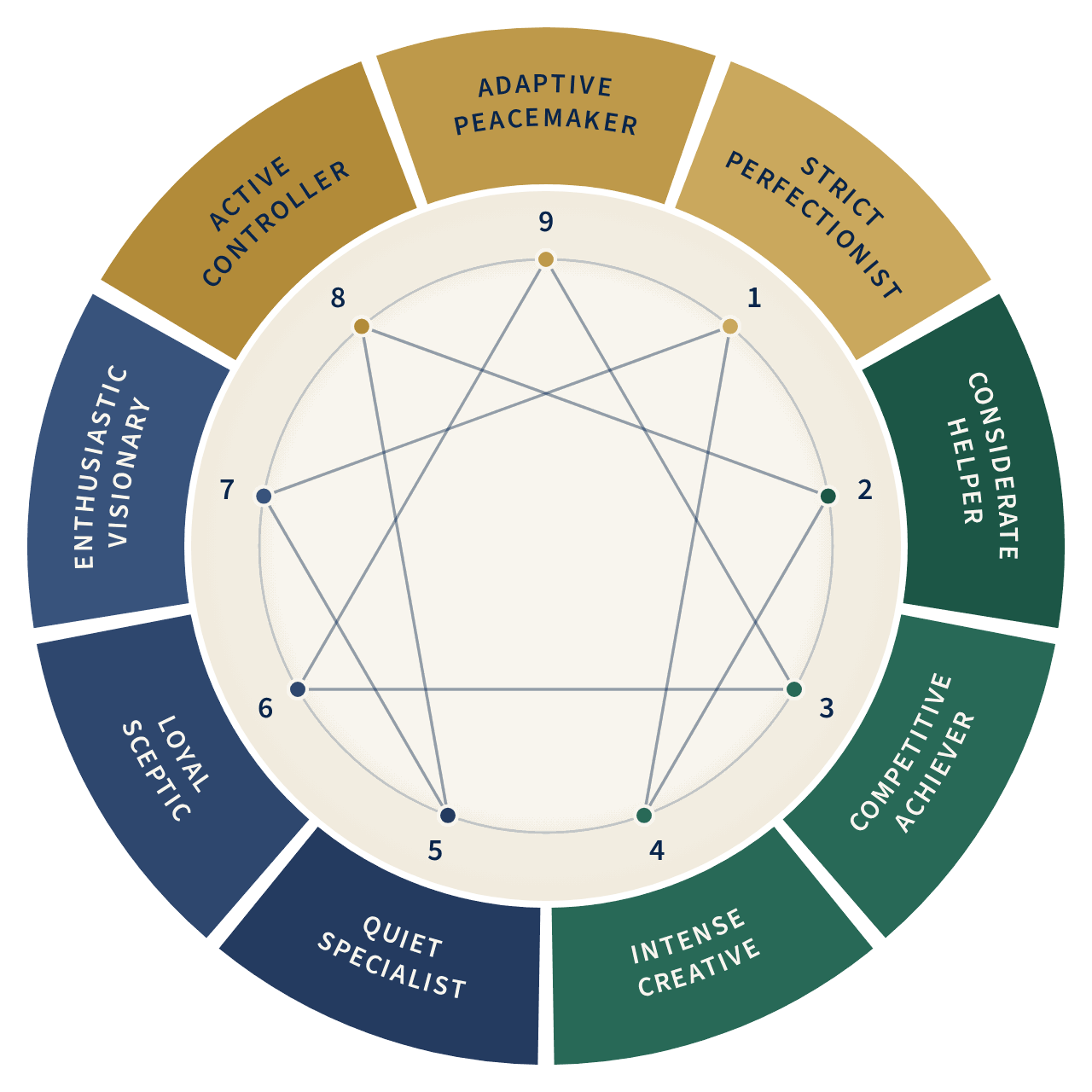
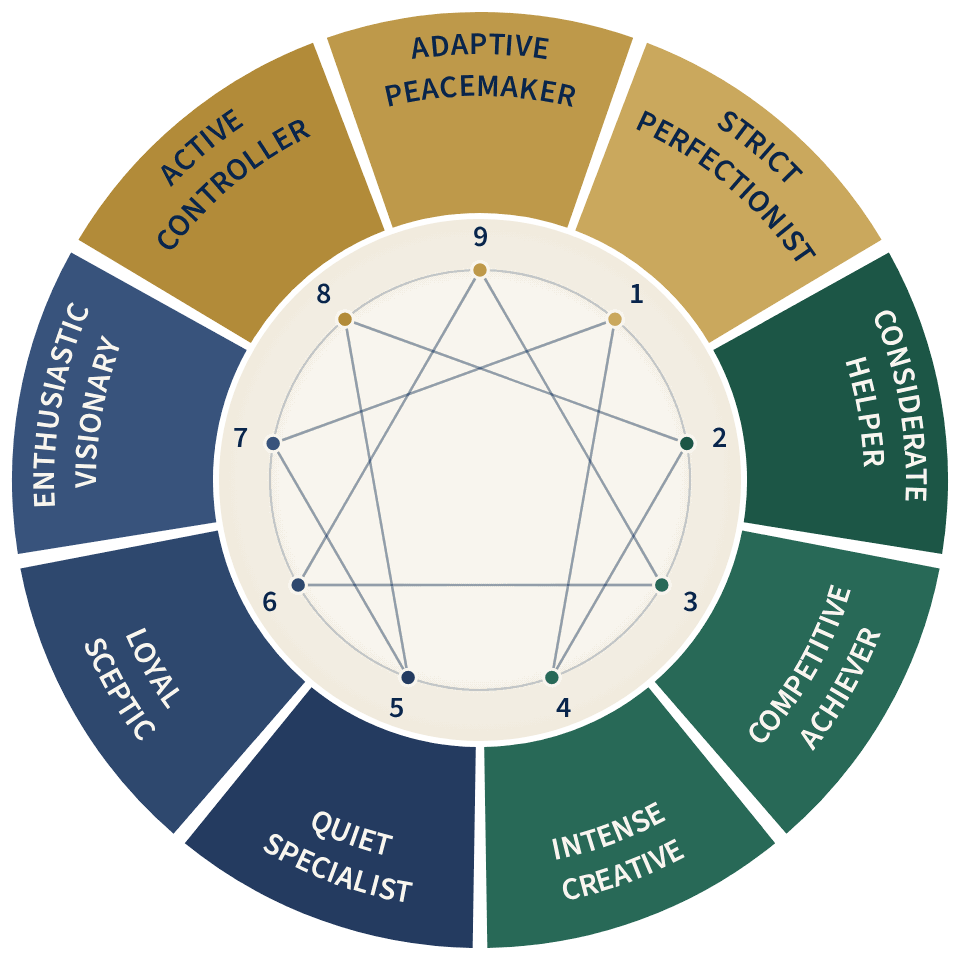
The symbol is a visual of the nine types. Each point on the circle is one type. The types are grouped in threes by whether a person tends to lead with thinking (insight and preparation), feeling (compassion and connection), or action (conviction and follow-through). The lines show where each type tends to go under stress and in growth. We read the symbol like a map, to see how the pieces relate.
Why Integrative Enneagram (iEQ9) instead of DiSC or a free test?
Tools like DiSC are useful for describing how you tend to behave, especially at work. The Enneagram focuses on motivation, the reasons behind how you think, feel, and act. That matters most under pressure. Knowing your type helps you notice when stress is pulling you into unhealthy patterns, so you can change course before those patterns shape how you lead or serve.
The Enneagram is often used loosely, though. People type themselves from a list of traits, or take a free quiz and walk away with a label they cannot act on.
The iEQ9 is more concrete. The questions adapt as you answer and cross-check easily confused types, so people sure of their number are sometimes surprised by how precisely the assessment describes their personality. Your report goes well past your type, includes development suggestions, and is yours to keep. Like any assessment, the iEQ9 serves your judgment, not the other way around.
Why use the iEQ9 in a faith-based practice?
We use the iEQ9 for accuracy and depth. No other assessment we have found identifies your Enneagram type as precisely. Depth means the report goes beyond your type to cover your motivations, strengths, and challenges, along with your subtype, your balance of thinking, feeling, and action, your level of self-awareness, and your current strain across six areas. The result is a full picture of you, enough to satisfy your curiosity without buying a stack of books. Without accuracy and depth, the Enneagram is easy to set aside before the benefit becomes clear.
The iEQ9 itself is written for a broad audience. Integrative Enneagram Solutions designs the assessment for coaches, leaders, and organizations of every background, so the reports speak to personality rather than faith, and the growth suggestions are general practices rather than spiritual disciplines.
Faith shapes the debrief and the resources that follow. In debriefs and team sessions, we explore results through the lens of Christian faith. Where helpful, we also recommend resources by Christian authors on spiritual formation, leadership, relationships, and other areas, based on your needs and interests.
What research supports the iEQ9?
The publisher, Integrative Enneagram Solutions, describes the iEQ9 as the world’s most accurate and comprehensive Enneagram assessment and reports the iEQ9 has been validated with nearly 64,000 people across five languages, certified by external psychometricians, and found reliable across all nine type scales.
One study is published in detail. In 2019, an independent research psychologist analyzed results from 5,910 people and found all nine type scales measured consistently, with answers sorting into nine groups matching the nine types. Each result also runs five reliability checks, such as how consistently you answered.
People are more than any assessment can capture. We treat what you learn as a starting point for conversation, and you are always free to disagree.
Which option is right for me?
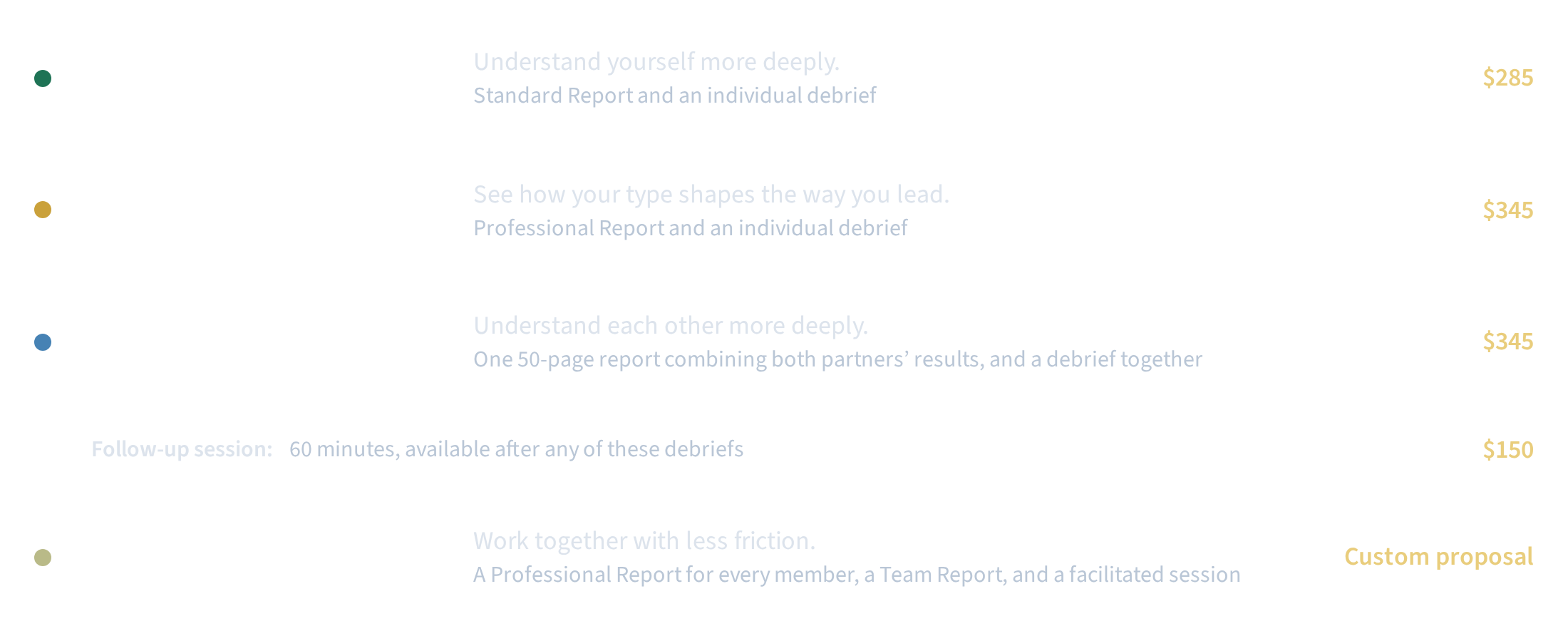
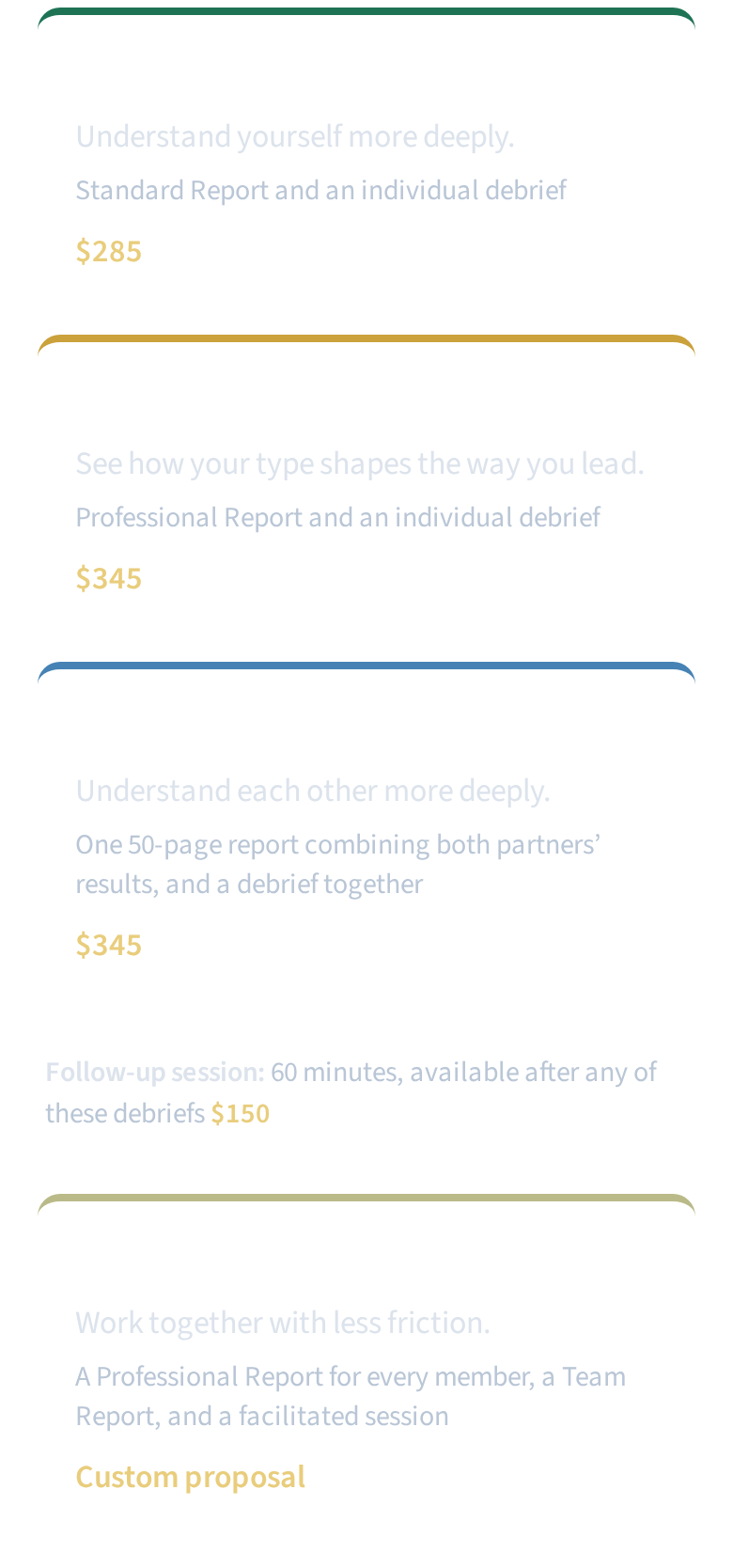
Self-Leadership is for understanding yourself. Includes the Standard Report (23 pages) and an individual debrief focused on your motivations, patterns, and growth.
Ministry Leadership is for leaders responsible for people, teams, or major decisions. You receive the Professional Report (42 pages), which adds communication, feedback, conflict, decision making, leadership, and teamwork, plus an individual debrief applied to how you lead.
Couples is for couples who are dating, engaged, or married. Both partners complete the iEQ9, and your results are combined into one 50-page Couples Report for your relationship, followed by a debrief together.
Team is for ministry teams of 3 to 12 people. Every member takes the assessment and receives a Professional Report (42 pages), and the team works through a Team Report (23 pages) in a facilitated session.
What is in each report?
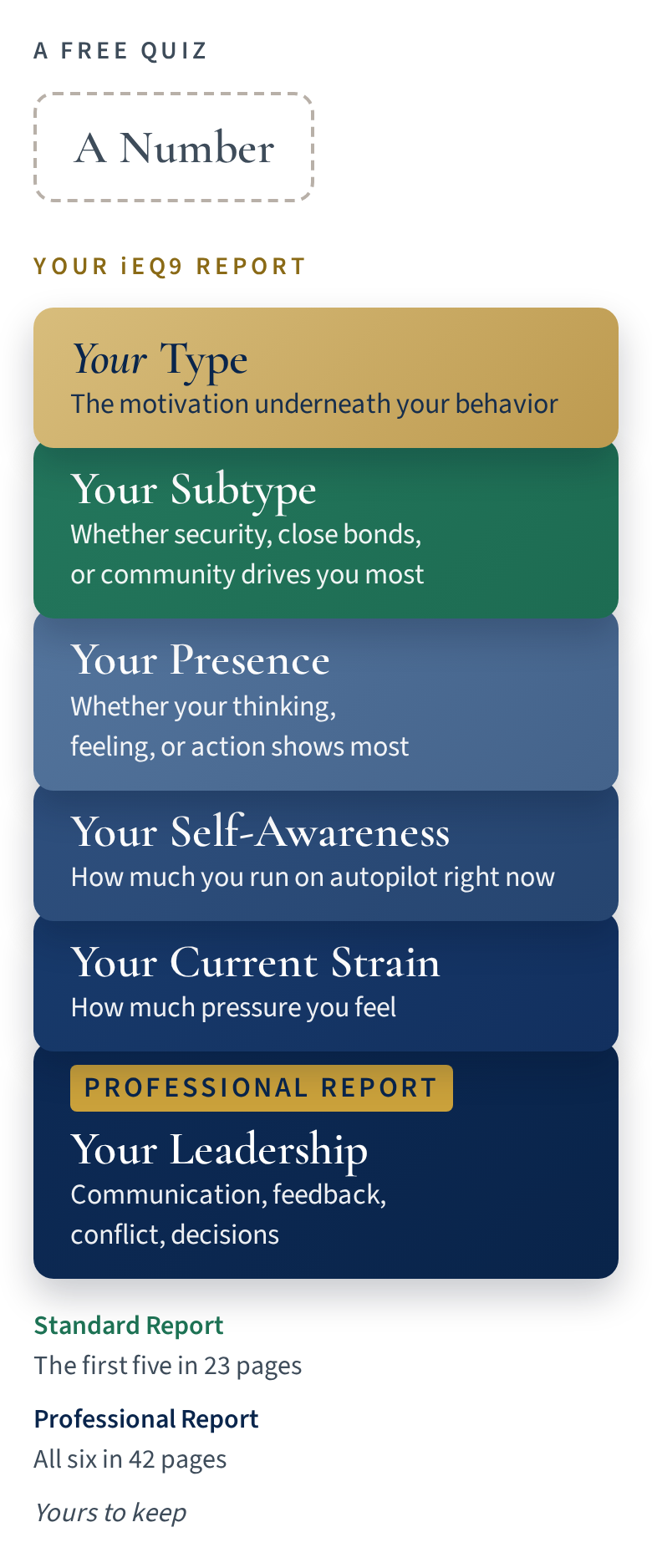
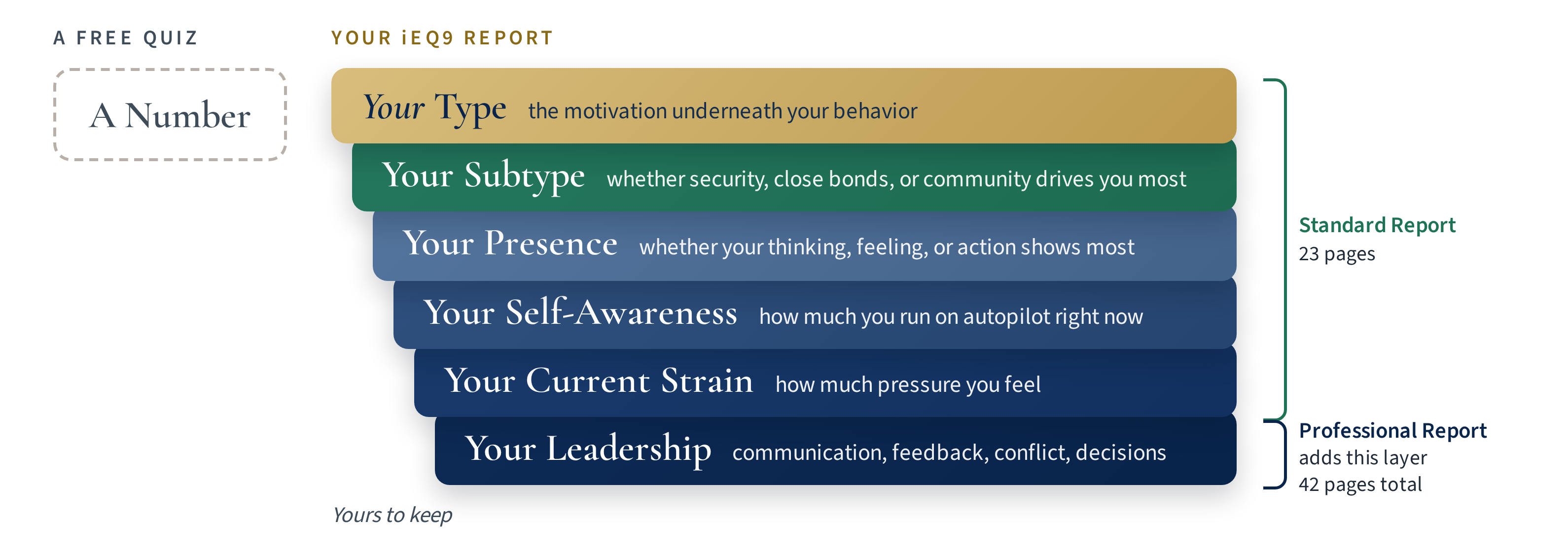
The Standard Report explains what motivates you, what you fear, and your strengths and growth areas. You also see the neighboring type that influences you most and whether your focus goes first to security, belonging, or close connection. The report shows how you balance thinking, feeling, and action, how self-aware you are right now, where you may be carrying strain, and how you respond under stress and as you grow.
The Professional Report includes everything in the Standard Report, then applies your type to how you work with people. You will see how you listen, communicate, give and receive feedback, and make decisions, and what sets you off in conflict, with steps you and others can take when you are triggered. A feedback guide covers all nine types, so you can adjust your approach to each person you lead. The report also covers how you plan, delegate, and motivate others, your natural role on a team, and how you show up in coaching.
The Couples Report is written about your relationship, not each person alone. The report explains what drives each of you, what you bring out in each other, and where your personalities tend to clash. You will see how each of you needs to be cared for, how stress is affecting each of you, and how your social needs differ. The report also covers communication, decisions, conflict, intimacy, parenting, money, and balancing work and home, with practical suggestions throughout.
The Team Report is written about the team as a whole, not each member alone. The report shows the team’s shared style and values, the perspectives the team is missing, and the unhealthy patterns to watch. You will see how the team’s style shapes relationships, planning, and goals, how the team handles conflict, and where the team is under shared strain. The report also shows the team’s stage of growth and how the team and the leader work together, with development suggestions throughout.
What happens after I reach out?
Individuals receive a link to complete the assessment online in about 30 to 40 minutes. Then we meet for a 90-minute individual debrief, and you leave with your report and a growth plan.
Couples each complete the assessment online. Once both partners finish, we meet together to talk through your Couples Report.
Teams start with a short scoping conversation, followed by a proposal. Every member completes the assessment, and then we hold a facilitated session and follow through on how your team decides, meets, and acts.
For teams, does everyone take part, and who sees results?
Every member of the group completes the assessment. The Team Report is designed for groups of 3 to 12 people who work together, so a larger staff or ministry might choose its leadership team or one ministry team. Because the report draws on every member’s results, one missing person leaves the picture incomplete. We ask the whole group to commit before we begin, and we name a team leader at the start.
Individual results and debriefs stay confidential. Your accredited iEQ9 practitioner sees each individual report, and the group sees the Team Report. We agree up front on anything else to share. Supervisors and boards do not see individual reports without permission, and we never use results to hire, screen, promote, remove, or judge anyone’s calling.
Myrtle Tree Ministry Strategies
Strategic excellence for fruitful ministries.
© 2026 Myrtle Tree Ministry Strategies. All rights reserved.